On 16 November 2026, the US Bureau of Industry and Security published an interim final rule that requires a licence before any data centre, anywhere in the world, can supply more than 12 million aggregate TPP of compute to a company headquartered in China or Macau. The rule took effect on 19 November. Four days later, Africa’s largest GPU build announced it was seeking another billion dollars to buy more of the same American chips. That sequence matters because it separates two things the market has been treating as one: owning the machine, and holding the authority to decide what the machine is allowed to do.
The sovereignty question is no longer whether a country can host AI infrastructure. It is whether the country that buys the hardware also inherits any power to govern the systems running on it. The early evidence from five African markets suggests it does not.
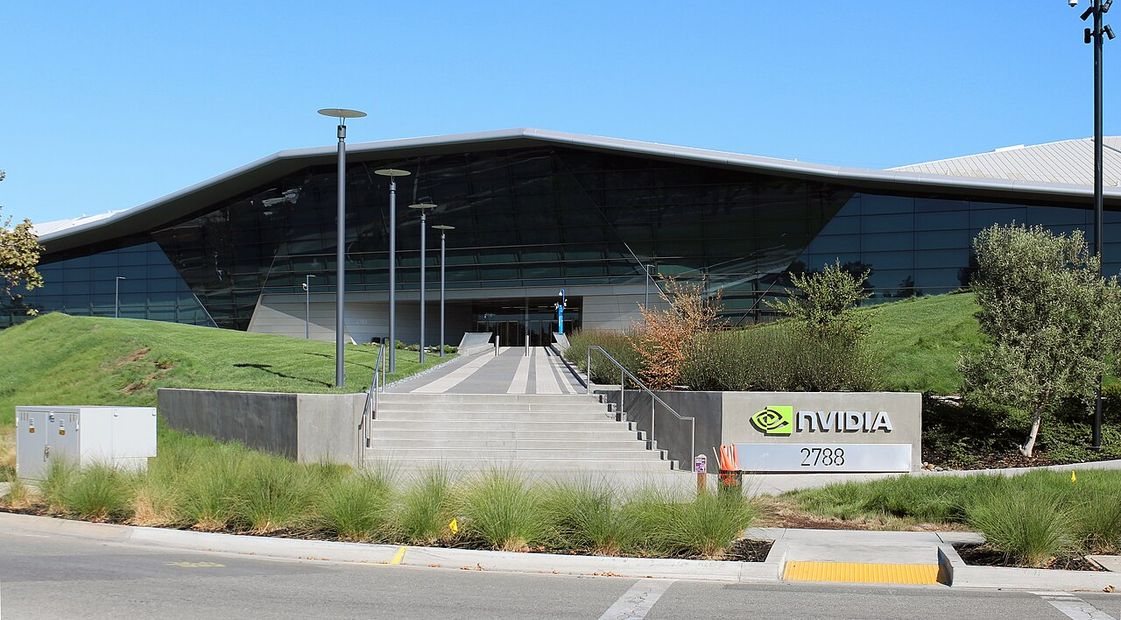
Featured image: NVIDIA headquarters, Santa Clara. Photo: Coolcaesar / Wikimedia Commons, CC BY-SA 4.0, via Charge Africa.
What the original report says
Charge Africa reported on 20 November 2026 that Nvidia has stopped shipping US-licensed Hopper data-centre chips to China, a business that Bloomberg estimates earned the company $2.4 billion in the quarter to 25 October. The halt was disclosed by interim chief executive Colette Kress on Nvidia’s third-quarter earnings call, without explanation. The report places the decision alongside the US Commerce Department’s stricter export checks issued on 16 November, which respond to concern that overseas buyers could give Chinese companies remote access to advanced chips. It also records that Cassava Technologies, the pan-African infrastructure group founded by Strive Masiyiwa, is in talks to raise up to $1 billion from US and Middle Eastern investors to buy Nvidia GPUs. Cassava plans 12,000 GPUs across South Africa, Nigeria, Kenya, Egypt and Morocco, and its Cape Town facility is running. The report’s point is structural: the terms on which African countries obtain compute are now set in Washington as much as in Santa Clara.
THE SCENARIO: A permanent secretary signs off on a national AI factory. The site is domestic, the power contract is domestic, the data stays inside the border, and the ribbon-cutting is carried on the evening news. Eighteen months later, the facility’s anchor tenant is told that a supplier licence is required before the hall can keep serving a regional client. Nobody in the capital has a signature on that decision. The ministry has the building, the billing relationship, and the press release, but it cannot convene the supplier, review the customer list, or rule on the question. The sovereignty it announced sits in the walls. The sovereignty it needs sits somewhere else.
The Question
The question is not whether African countries should buy GPUs. They should, and the shift from roughly eighty Nvidia GPUs on the continent to a planned twelve thousand is a genuine change in capability. The question is what a state actually acquires when it acquires compute on terms written by another government.
Three things travel with a chip shipment. There is the hardware, which can be bought and installed. There is the software stack, which is licensed and revocable. There is the legal regime governing who may use the hardware and for what, which now extends to the customer list of the data centre that houses it. A country can buy the first outright, negotiate access to the second, and hold almost no influence over the third. Treating all three as a single procurement decision is the error.
That matters because the word sovereign is doing heavy lifting in a market where the capital, the silicon and the models are largely foreign. The sovereignty test is not whether a data centre stands on national soil. The sovereignty test is whether a named institution inside the country can overrule, explain or halt a system operating in it. This article asks who holds that authority once the ribbon is cut.
What Happened and Why It Matters
The US Commerce Department’s Bureau of Industry and Security issued its interim final rule on 16 November 2026. The Federal Register published it on 19 November as document 2026-23529, and it took effect that day, with comments open until 19 January 2027. Under the new § 744.24, a licence is required for exports, reexports or in-country transfers of advanced super-intelligence items where there is knowledge they will be used in a data centre that supplies more than 12 million aggregate TPP to entities headquartered in Macau or in Country Group D:5.
The rule also adds licence requirements for advanced chips sent to Indonesia, Malaysia, Singapore, Thailand and Brazil, with an exemption for US-headquartered end users that meet reporting conditions. It formally rescinds the Biden-era AI Diffusion Rule. And it places due diligence obligations on foreign data centres, which are now expected to perform robust checks on customer ownership and control so that companies cannot route demand through corporate restructuring.
TechCrunch reported that 12 million TPP corresponds roughly to the maximum computing power of several hundred H100 or H200 chips. Charge Africa put the equivalent at around 760 H100 chips and noted that the threshold reaches African markets directly: an operator in Lagos, Nairobi or Johannesburg wanting to rent large GPU capacity to Chinese-headquartered customers would need a US licence first. No African country appears on the five-country list. The exposure is commercial, not national.
Nvidia’s own disclosure came on the earnings call days later. Kress said the company is no longer shipping licensed Hopper data-centre products to China. Bloomberg’s estimate of $2.4 billion in the prior quarter is about two per cent of Nvidia’s $107.6 billion data-centre revenue, so the company can absorb the loss. The signal is what carries: a class of legal product became unavailable to a major market without any public explanation, and the forecast simply assumed the revenue away.
The African build sits inside that frame. Cassava technologies has committed up to $720 million to place 12,000 Nvidia GPUs, with 3,000 in South Africa already, a 20-megawatt site planned in Johannesburg, and the remainder distributed to Kenya, Nigeria, Morocco and Egypt over three to four years. CIO Africa reported Cassava’s own account that the chips have been bought and are arriving in about 28 containerised shipments. In Egypt, Vodafone Business and Cassava launched a facility described as the country’s first sovereign AI factory, with Elsewedy Electric, targeting 20 megawatts within three years and 200 megawatts long term. Egypt’s Ministry of Communications puts first-round foreign investment at about $200 million, rising towards $1 billion at full capacity.
That matters because the ownership structure behind the build is not domestic. Nvidia and Google are shareholders in Cassava. Cassava AI, incorporated in London in 2024, works with Google, Microsoft, Amazon Web Services and Anthropic, and in October became an authorised reseller of Anthropic’s Claude models through Amazon Bedrock. The African contribution is the building, the power contract and the customer relationship. Cassava’s president and chief executive, Hardy Pemhiwa, has been direct about the priority: what matters to customers is being able to use AI in their business.
Compare that with Kenya. Its Office of the Data Protection Commissioner published an AI guidance note in July. Section 6.6 sets out five expectations: decisions should not be made by automated means alone without meaningful human involvement; the affected person must be told; they may ask for human review; the organisation must explain the logic when asked; and a contested decision must be reviewed by a human with authority to reverse it. Kenya achieved that without a single additional GPU.
All of that diplomacy is necessary. None of it substitutes for a domestic decision right.
The Sovereignty Risk
The risk is not a chip embargo. It is a governance gap that opens quietly while the infrastructure succeeds. A state can reach its megawatt targets, fill its halls and attract anchor tenants, and still find that the decisions that matter are made under someone else’s statute. The BIS rule is explicit that its reach follows the customer, not the cable. That is a reasonable national security position for Washington. It is also a statement about where authority over a foreign data centre’s order book now sits.
Three dependencies compound. The first is supply. Silicon, networking and the software frameworks that make a GPU cluster usable come from a small number of American vendors, and Nvidia’s own results release named new infrastructure in Australia and Europe but no African country. The second is commercial. Financing at this scale is being raised from US and Middle Eastern investors, which means the balance sheet carries geopolitical covenants before a single model runs. The third is legal. The Malabo Convention came into force in June 2023, yet only 20 of 55 member states had ratified or acceded by February 2026. None of the five countries receiving Cassava’s GPUs had ratified, according to Strathmore University’s CIPIT, which counted 44 African countries with data protection laws and 37 with working authorities.
That last point is the sharpest. The countries buying the compute have not signed the continent’s own rules on data and cybersecurity. Sovereignty is being purchased in hardware while the legal instruments that would give it force remain unratified. This is not a failure of ambition. It is a sequencing error, and sequencing errors are fixable.
The accountability gap follows. When a data centre operates inside a country but answers to a foreign licence regime and foreign shareholders, who is accountable when something goes wrong? The operator holds the power contract. The vendor holds the product. The investor holds the exit. The regulator, in many of these markets, holds a mandate drafted before AI factories existed. For leaders, the practical issue is not whether the supply chain is foreign, which it will be, but whether a named domestic institution has the authority, the evidence and the technical staff to intervene.
Institutional capability is the missing layer. Kenya’s guidance note is powerful because it creates a decision right: a human with authority to reverse. A data centre with no such mechanism is a very expensive building. The sovereignty test here is not rhetorical. It asks who signs, who can be compelled to explain, and who bears the cost of a wrong answer.
The TEE Method Response
The TEE Method works through three levers: Talent, Enterprise and Ecosystem. Talent is the people who can specify, audit and operate the system. Enterprise is the institutional machinery that holds the decision right. Ecosystem is the set of domestic partners, suppliers and standards bodies that reduce single-point dependency. Applied to compute sovereignty, each lever addresses a gap that money alone cannot close.
Talent first. A national AI factory needs more than engineers who can rack servers. It needs people who can read a supplier licence, assess a customer due diligence file, and explain to a minister why an order is being declined. That is a small, specific, trainable cadre. Kenya’s data protection office produced a workable rule with a legal team and a guidance note. The same discipline applied to procurement is the highest-return investment available, and it costs a rounding error against a 20-megawatt build.
Enterprise second. The decision right has to sit somewhere with statutory force. If a data centre operates under a foreign licence regime, the domestic regulator must at minimum hold a corresponding disclosure right: what workloads are running, who the customers are, what thresholds have been crossed, and under whose authority a service was suspended. Without that, the state learns about constraints from press coverage, as it did with the Hopper halt.
Ecosystem third. Single-supplier exposure across five countries, one distributor and one chipset is a concentration risk that lenders will eventually price. Diversification does not mean building fabs. It means contractual interoperability, credible second-source options, regional power and connectivity arrangements, and a shared standards position across the markets receiving the same hardware. The African Union’s own instruments exist. Ratifying them is the cheapest sovereignty purchase on the table.
Where the three levers meet, the result is a country that can host AI infrastructure and still govern it. Where they do not, the result is capacity without authority, which is the precise condition the BIS rule has now made visible to every finance ministry on the continent.
Sovereignty Test Matrix
The matrix below scores the African compute build across five domains, each rated from one to five, where one represents nominal sovereignty and five represents durable sovereignty. The scores are an assessment of the evidence cited above, not a judgement on any single company or government. The purpose is diagnostic: to show where authority actually sits.
| Domain | Score | Weak signal | Stronger signal |
|---|---|---|---|
| Political | 2 / 5 | Sovereignty announced at a festival; no statutory decision right over foreign-licensed workloads | Named regulator holds disclosure and suspension authority over data centre customers |
| Economic | 2 / 5 | Capital, silicon and shareholder equity foreign; exit is offshore | Domestic co-investment, priced second-source options, contract terms that survive a supplier change |
| Cultural | 3 / 5 | Models and interfaces optimised elsewhere; local languages and services secondary | Local-language workloads and public-interest applications specified as anchor demand |
| Intellectual | 2 / 5 | Assessment capability sits in the vendor’s technical documentation | Domestic technical staff able to audit licences, due diligence files and model behaviour |
| Technological | 3 / 5 | Single chipset, single distributor, single supplier relationship | Interoperable stacks, credible alternatives, shared regional standards position |
The political score is the lowest and the most consequential, because it sets the ceiling on the rest. A state that cannot name the institution holding the decision right cannot credibly direct its own infrastructure, however much of it sits behind a domestic fence. The economic score reflects a genuine constraint rather than a policy failure: at this capital intensity, foreign investment is not optional. The test is whether the terms preserve any room to manoeuvre when a supplier’s position changes.
The technological score is the most improvable in the short term. Interoperability, contractual portability clauses and regional procurement consortia are administrative decisions, not industrial policy. Cultural and intellectual scores move more slowly, but they move first in the institutions that specify what the infrastructure is for. A compute programme with no stated public-interest workload will drift towards whoever pays the invoice.
What Leaders Should Do This Week
The actions below are scoped to a week because the window is short. The BIS rule has a comment period closing on 19 January 2027, existing operators serving affected customers must obtain a licence within ninety days of the effective date, and financing negotiations for the next tranche of African GPU capacity are live now. Each action should have a named owner.
First, map the customer base against the threshold. The relevant question for every data centre operator is whether any customer is a subsidiary of an entity whose ultimate parent is headquartered in Macau or Country Group D:5, and whether that customer’s share of the hall exceeds the compute equivalent of a few hundred advanced accelerators. Put the answer in writing this week, before an investor’s counsel asks for it.
Second, put a disclosure right into law or regulation. A ministry that can require a data centre to report its customer profile, workload classification and licence status has practical sovereignty. A ministry that receives that information only on a voluntary basis does not. Kenya’s guidance note shows the drafting is achievable at low cost.
Third, staff a supply licence review function. Two to four people who can read a US export licence condition, understand what a change in end use means, and brief a permanent secretary in plain terms. This is a talent decision, and it can be built inside one budget cycle.
Fourth, ratify what already exists. The Malabo Convention and the AU’s data governance instruments are sitting unratified in the same countries buying the compute. Ratification costs political capital rather than cash, and it converts a moral claim into an enforceable one. Name the ministry official responsible for the instrument and the date it will table.
Fifth, write the exit and continuity clause before signing the next tranche. If a supplier changes policy, if a licence is refused, or if a shareholder exits, what happens to the workloads, the customers and the data? Cassava’s current fundraising is exactly the moment to negotiate that clause, not after the contract is settled.
Sixth, publish one workload that serves the public interest. Sovereign compute with no stated public purpose is a commercial real-estate proposition. Naming a health, language or public-service application as anchor demand gives the build a domestic rationale that survives a change of supplier.
Seventh, coordinate regionally before the next procurement round. Five countries are buying the same chipset from the same distributor under the same foreign legal regime. A shared position on interoperability, pricing and continuity terms is leverage that none of them holds alone. The decision threshold is simple: if the answer to the question of who can stop a system operating in a given territory is a person outside that territory, the sovereignty claim is not yet true.
The Question Revisited
The question was what a state acquires when it acquires compute on terms written by another government. The answer is that it acquires capacity, evidence and risk, but not authority. The BIS rule of 16 November made that explicit, and Nvidia’s quiet withdrawal of licensed Hopper sales to China made it concrete. The legal regime governing an AI factory now follows the customer and the ownership chain, wherever the building stands.
That is not an argument against building. The move from around eighty GPUs on the continent to a planned twelve thousand is a real gain, and the Egyptian and South African facilities are genuine assets. The argument is that capacity and authority are purchased separately, and the second purchase is cheaper. Kenya demonstrated it with a guidance note. Ratification, statutory disclosure rights, a small licensing review team and a continuity clause all cost a fraction of a single hall.
Through the TEE Method, the resolution is sequenced rather than dramatic. Talent produces the people who can read the licence. Enterprise creates the institution that holds the decision right. Ecosystem reduces the single-point dependency that makes the decision right negotiable.
Leaders who want to test their own position can do so in one question: name the person, in your jurisdiction, with the power to overrule a machine. If the name comes easily, the sovereignty is real. If it does not, the ribbon was cut in the wrong place.
Editorial note: This is a news-led Sovereignty Briefing analysis produced with Hermes-assisted research and source checks.
Sources
Charge Africa, “Nvidia China chip shipments halted: what it means for Africa,” 20 November 2026. Primary source for this analysis, including the Nvidia earnings call disclosure and the Cassava fundraising report.
Federal Register, “Addressing Remote Access to Advanced Semiconductors,” Document 2026-23529, 91 FR 74970, Bureau of Industry and Security, 19 November 2026. The interim final rule and its § 744.24 data centre end-use control.
US Bureau of Industry and Security, press release, 16 November 2026.
CIO Africa, “Sovereign AI: Africa Buys Chips, Not Rules,” 19 November 2026. Cassava’s GPU deployment figures, the Egypt joint venture, ownership details, and Kenya’s Office of the Data Protection Commissioner guidance note.
Semafor Africa, “Nvidia CEO’s exit marks pivotal moment for African AI,” 13 November 2026.
TechCrunch, “US tightens AI chip export controls to deter Chinese companies from accessing compute remotely,” 16 November 2026. The 12 million TPP threshold in accelerator terms.
Featured image: NVIDIA headquarters in Santa Clara, photograph by Coolcaesar, Wikimedia Commons, CC BY-SA 4.0, sourced from the Charge Africa article cited above.
This article draws on the TEE Method™ framework from SOVEREIGN: Who Owns the Future? For the complete framework, see tonishatagoe.com.
Sign in to save