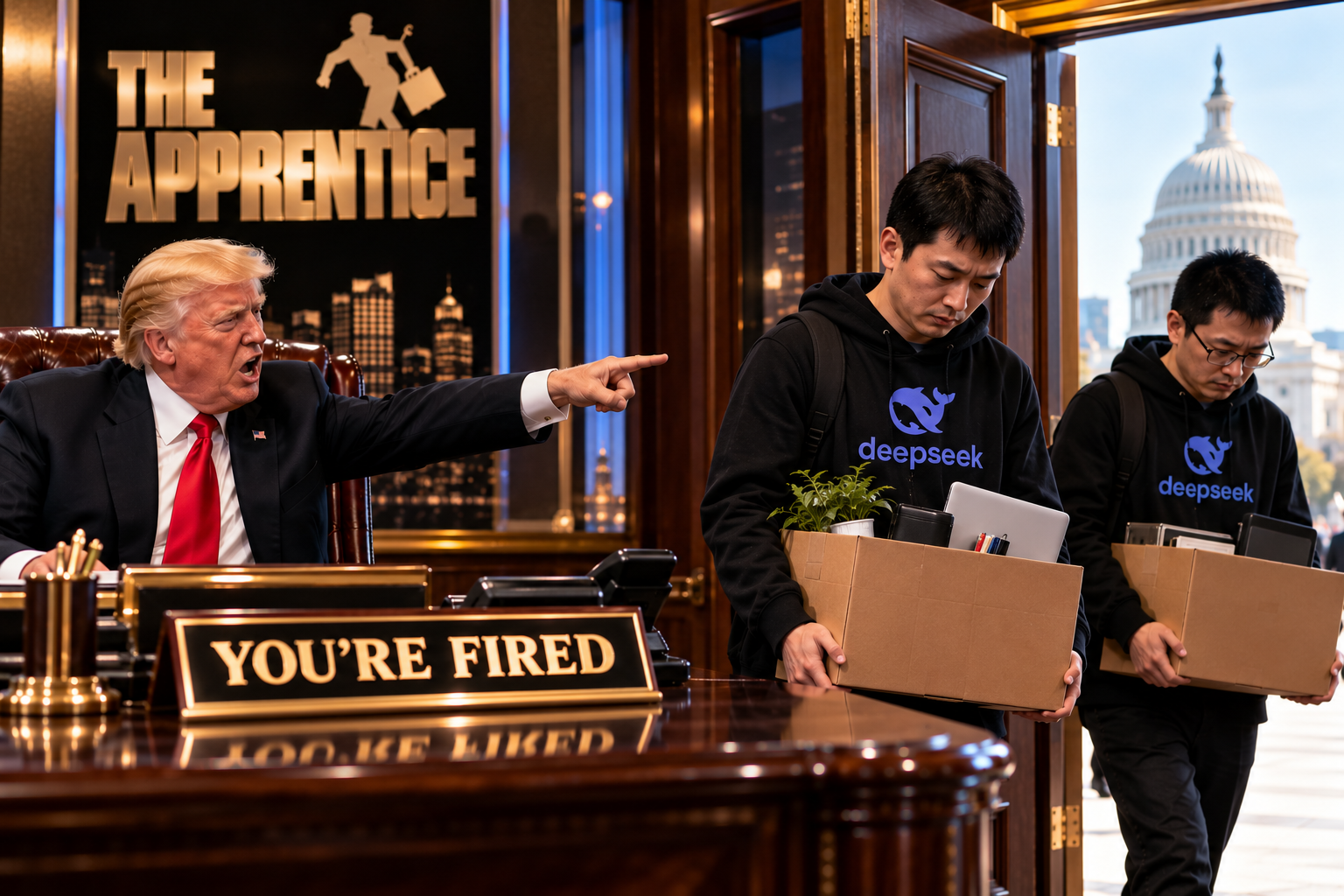
On 20 October 2026 the United States Department of Homeland Security published an order that bars DeepSeek products from federal civilian procurement and requires their removal from agency systems. The operative sentence reaches further than the company. It also removes “third-party products and services developed using DeepSeek implementations.” Officials never defined what that phrase covers. That single undefined phrase has now moved model lineage — the question of which models a product was built from, or trained on — out of engineering documentation and into acquisition risk. For every institution that buys or builds with AI, the practical sovereignty question has changed shape. It is no longer only where a model runs. It is who made it, and whether the buyer can prove what it inherited.
Featured image: theCUBE Research, “Washington Just Banned an AI Model for Having the Wrong Parents”, 26 October 2026.
What the original report says
The primary source is the Federal Register notice of order published by the Department of Homeland Security on 20 October 2026, covering Exclusion and Removal Order #2026-01 signed by Secretary Markwayne Mullin on 24 July 2026. The notice does two things. It excludes information technology products and services developed by Hangzhou DeepSeek Artificial Intelligence Co., Ltd, including affiliated entities, from federal civilian agency procurements. It also requires the removal of all DeepSeek and DeepSeek-affiliate products, together with third-party products and services developed using DeepSeek implementations, from civilian agency information technology. The authority is the Federal Acquisition Supply Chain Security Act of 2018. It is the first FASCSA order issued by DHS and the first to cover all federal civilian executive branch agencies. The order publishes the threat rationale, an exception route through CISA, and a review to be conducted within one year and annually thereafter. It does not define “DeepSeek implementations”.
THE SCENARIO: A health agency’s procurement director receives a written request from its own legal team. Certify that no system in the agency’s estate was built using a restricted model family. The estate runs forty-one applications. Eleven embed a commercial AI feature. Two were fine-tuned in-house eighteen months ago by a contractor that has since changed hands. The coding assistant the engineering team used that year has been retired, and its vendor has never said which models sat behind it. The director can answer the runtime question in a day. The lineage question has no answer at all, and the certification is due in three business days.
The Question
When a regulator can disqualify a technology because of what it was built from, not only where it runs, who inside the institution holds the evidence of lineage, and can that evidence survive a challenge?
The DeepSeek order is usually read as a China story. That reading is too comfortable, and it lets most institutions off the hook. The order is better understood as a procurement story with a technical footnote. A government decided that jurisdiction follows the product, that a vendor’s incorporation and the law it answers to travel with the product wherever it is hosted, and that a third party’s inherited components are the prime contractor’s problem. That reasoning is now public, written down, and citable by any buyer with leverage.
The question is not whether DeepSeek is a risk to a given enterprise. Most readers of this briefing are not federal contractors, and few of them run DeepSeek in production. The question is whether the institution could answer the lineage question if it were asked next week, by a customer, an auditor, an insurer, or its own board. That matters because the ability to answer is a form of sovereignty, and the inability to answer is a form of dependency dressed up as agility.
There is a second-order question underneath. If lineage becomes a condition of market access, then the organisations that record lineage well will set the terms for those that do not. Provenance stops being a compliance cost and becomes a commercial asset. The sovereignty test is whether the institution owns that record or rents it from the vendor whose product the record describes.
What Happened and Why It Matters
The order’s history matters as much as its text. It was signed on 24 July 2026 and appeared in the Federal Register on 20 October 2026, a gap of eighty-eight days. The Federal Register notice, published as 91 FR 66346 under docket DHS-2026-0628, sets out two limbs. The first excludes products and services developed by DeepSeek and its affiliates from federal civilian agency procurements. The second requires removal of DeepSeek products, DeepSeek-affiliate products, and third-party products and services developed using DeepSeek implementations from civilian agency information technology. It applies to federal civilian executive branch agencies, excluding their national security and sensitive compartmented information systems.
The Congressional Research Service summarised the order on 27 October 2026 and placed it in a sequence. The Department of Defense issued a similar exclusion and removal order for DeepSeek on 8 September 2026, and the Director of National Intelligence issued one concurrently with DHS. CRS also recorded that DHS had not used this power before. The order is the first FASCSA exclusion and removal order from that department, which makes it a precedent rather than a routine procurement decision.
The stated rationale is specific. CRS summarised the notice’s reasoning: DeepSeek is subject to Chinese law, including a 2017 cybersecurity law that could compel disclosure of sensitive information; creating an account requires collection of personally identifiable information; the service collects inputs and outputs; and leaked information could be combined into actionable intelligence. The order also states that the models themselves may contain malware or other security vulnerabilities, citing open-source research on the DeepSeek iOS application.
Commerce and industry coverage stressed the breadth rather than the target. CNBC reported on 20 October 2026 that the ban covers third-party products and services built using the company’s technology, and noted the order excludes the Department of Defense while applying to civilian agencies such as Treasury, State and Justice. It also reported that China’s foreign ministry said it would safeguard the interests of its companies, with spokesperson Mao Ning saying China opposes the over-generalisation of national security.
The most consequential analysis came from the Cloud Security Alliance, in a research note published on 21 October 2026. Its central finding is simple and uncomfortable: the order’s operative phrase is never defined. The Alliance set out a graded reading of what “developed using DeepSeek implementations” might reach. The hosted app and API are directly covered. Self-hosted DeepSeek weights are very likely covered, because the weights are the implementation. Fine-tunes, adapters, quantisations and merges of DeepSeek checkpoints are likely covered, because the weights inherit DeepSeek parameters. DeepSeek’s own published distils of other vendors’ base models are likely covered, because DeepSeek published them. Third-party distillation and synthetic training data built from DeepSeek outputs are uncertain, because that turns on whether “developed using” reaches training inputs. AI-assisted code generation with a DeepSeek-backed coding assistant is uncertain but very hard to detect.
Two numbers from the Alliance note explain why the lineage question is not theoretical. As of 21 October 2026, the DeepSeek organisation on Hugging Face listed more than 100 public model repositories, and Hugging Face’s model-tree metadata recorded more than 500 community models declaring DeepSeek-R1 alone as their base model. That is a family tree, not a product line. A single upstream checkpoint can be present, in modified form, in hundreds of downstream artefacts that carry no obvious marker of their origin.
Timing compounds it. The Alliance noted that agency exception requests were due within sixty days of issuance under the order’s process, and that window closed around 22 September 2026, roughly four weeks before the public could read what it was an exception to. For contractors, where the FAR 52.204-30 clause is in a contract, the duties are already live: search SAM.gov for applicable orders, report a covered article within three business days of identifying it, and flow the clause down to subcontractors. The Alliance’s judgement is that the period before a contract modification is a time for discovery, not a grace period.
Why it matters beyond Washington is that the reasoning is portable. The D.C. Circuit upheld the exclusion of Anthropic from the Department of War’s supply chain on 25 September 2026 under the same statute, accepting that a developer’s training methodology could itself constitute a supply chain risk even where the developer cannot access the deployed model. Law-firm analyses of that judgment noted the court’s broader reading of supply chain risk under FASCSA. Put the two decisions together and the doctrine is clear. What a model was trained to do, and what it was built from, are now procurement facts in the United States, on both sides of the political argument.
Europe is heading to a testable version of the same requirement from a different direction. The European Commission’s AI Office has had enforcement powers over general-purpose AI providers since 2 August 2026. In October 2026, Executive Vice-President Henna Virkkunen confirmed in Dublin that the AI Office had begun enforcement, sending requests for information on security, external evaluation and post-deployment monitoring. Separately, the Article 50 machine-readable marking obligations for synthetic content, delayed for systems already on the market, apply from 2 December 2026. One regime asks what is inside the model. The other asks what is inside the output. Both require records the buyer does not currently hold.
The Sovereignty Risk
The power shift here is quiet and it runs in an unexpected direction. Historically, sovereignty arguments concerned where data sits and who can reach it. The DeepSeek order keeps that concern but adds a second axis: whose law the model’s origin answers to, regardless of where the model runs. That means a buyer can satisfy every data residency commitment in its contract and still fail the test, because residency was never the test. The Alliance noted that most of the order’s threat rationale, particularly the data-flow risk from services hosted in a jurisdiction with broad government access powers, applies equally to regulated enterprises outside the order’s legal scope.
The dependency is evidentiary rather than technical. Institutions can swap a model. Almost none can reconstruct which models generated their training data, evaluation sets or code eighteen months ago, because nobody recorded it at the time and the information is not reliably recoverable from the weights afterwards. That creates a specific asymmetry. The vendor knows, or could know, the lineage of its own product. The buyer generally cannot verify it. Every certification the buyer issues therefore rests on supplier assurance, and supplier assurance is a permission, not a capability.
The Alliance’s distinction between an inventory problem and an evidentiary problem is the most useful framing available. An inventory problem is tractable. Whether a product calls an API, self-hosts weights, ships a fine-tune or bundles a published distill can usually be established from network egress logs, API keys, model inventories, weight hashes and base-model metadata. An evidentiary problem is not tractable with current tooling. A vendor whose model was partly trained on another model’s outputs, or whose evaluation set was built with them, or whose product code was written with a coding assistant running on them, generally cannot prove the negative.
The accountability gap follows from that. If a regulator asks a question the institution cannot answer, the institution absorbs the consequence: exclusion, delay, an unwound contract, a public correction. The upstream party that created the ambiguity faces no comparable exposure unless the contract says so. That is the sovereignty risk in one sentence. The party with the least information carries the most liability, and the party with the information has no duty to record it.
Institutional capability is the fourth exposure, and it is the one that compounds. Procurement teams are staffed to test price, security posture, service levels and liability. They are not staffed to interrogate model lineage, base-model metadata or training-data provenance, because until recently those were not procurement categories. The skills sit in engineering and data science, in teams that do not usually sit in the room when a contract is awarded. Closing that gap is not a technology purchase. It is a staffing and process decision, and it takes longer than a procurement cycle.
Finally, there is a strategic concentration risk that no individual buyer controls. If exclusion orders can follow a model family across jurisdictions, hosting arrangements and licences, then the market for substitutes narrows. A buyer who has kept model substitution technically practical can respond through configuration. A buyer whose application logic is welded to one provider’s behaviour must re-engineer under time pressure. The sovereignty test is not whether the institution has a second supplier. It is whether the institution could use one without rewriting its systems.
The TEE Method Response
The TEE Method organises a governance response around three assets: Talent, Enterprise and Ecosystem. Talent is the human capability to ask and answer hard governance questions. Enterprise is the internal machinery — process, contract, record, decision rights — that turns capability into repeatable control. Ecosystem is the external network of suppliers, regulators, peers and standards bodies whose choices shape the institution’s options. Applied to model lineage, the method produces three different, complementary moves rather than one procurement fix.
On Talent, the practical requirement is a named owner for model provenance, sitting where procurement, legal and engineering meet, with the authority to block an award. That sounds bureaucratic until the alternative arrives in writing with a three-day deadline. The capability required is not deep machine-learning expertise. It is the ability to read a model card, recognise base-model metadata, ask a supplier a precise question about distillation and evaluation data, and know when the answer is evasive. Most institutions already employ people who could do this. Almost none have assigned them to it.
On Enterprise, the move is to change what the contract requires before the market makes it a condition. Contracts should require suppliers to disclose model lineage — base model, fine-tuning and adapter chain, quantisation source — and to notify the buyer when a regulatory action affects a component. They should require attestation covering development-time use, not only runtime deployment, because the order’s live question is about development. They should also require an exit path that has been tested, not merely drafted. The Alliance’s recommendation is blunt: keep model substitution practical through model-agnostic gateways and tested fallback paths, so that exposure to a future exclusion order is addressed through configuration rather than re-engineering.
On Ecosystem, the institution should treat machine-readable provenance as a shared standard rather than a private filing habit. Formats such as CycloneDX ML-BOM and the SPDX 3.0 AI profile exist, and the Alliance’s assessment is that adoption remains uneven and that training-data lineage is the layer least often captured. Institutions that adopt these formats early gain two things: a defensible record, and the standing to ask suppliers to meet the same standard. Sector bodies and public buyers are better positioned than individual firms to make that ask, because they can attach it to market access rather than to a single negotiation.
The three assets reinforce each other in a specific order. Enterprise process without Talent produces paperwork that nobody can defend under questioning. Talent without Enterprise process produces a good answer from one person that does not survive their departure. Ecosystem engagement without either produces standards the institution cannot implement internally. The sequencing matters: name the owner, change the contract, then press the market.
Sovereignty Test Matrix
Score each domain from one to five, where one is absent and five is strong. The instrument is deliberately short. Its purpose is to expose the one or two domains where the institution could not survive a lineage challenge, not to produce a comfortable average.
| Domain | Weak signal (1-2) | Stronger signal (4-5) |
|---|---|---|
| Political | Lineage asked only when a regulator or customer raises it; no named accountable owner | A board-level owner for model provenance with documented decision rights and a block authority |
| Economic | Substitution cost unknown; exit assumed to be a contract clause rather than an engineering project | Cost and time to replace each production model documented and tested within the last year |
| Cultural | Provenance treated as vendor paperwork; engineering cannot describe its own model estate | Lineage questions treated as normal engineering practice, asked internally before any external request |
| Intellectual | No inventory of base models, weights, adapters or development tooling; records informal | Machine-readable model inventory with base-model metadata, weight hashes and development-tool logging |
| Technological | Model calls welded into application logic; no gateway, no tested fallback | Model-agnostic gateway, tested fallback path, exercised at least once per year |
The pattern to look for is a wide spread. A score of five on technological and one on intellectual is worse than a uniform three, because it describes an institution that can switch models but cannot prove it needed to, or prove what it inherited when it did. Uniform middling scores suggest a real programme with gaps. Wide spreads suggest a programme that exists in one team’s head.
What Leaders Should Do This Week
These are sized for one week of leadership attention. Each should be assigned to a named person with a date attached, and none of them requires a new platform purchase.
First, name the owner. Appoint one accountable executive for model provenance, with a documented right to block an award or a go-live where lineage cannot be evidenced. Record the appointment in the risk register, not only in an email. This single step converts a diffuse concern into a decision that somebody owns.
Second, build a flat list of every model in production, in procurement, and in the development pipeline, including models embedded inside commercial software and coding assistants. For each entry, record the model family, version, hosting location and supplier. The Alliance’s advice is explicit that this must go beyond vendor-level questionnaires, because AI-enabled products increasingly route between several underlying models. A spreadsheet that is accurate beats a platform that is not.
Third, send a written lineage request to every supplier on that list. Ask specifically about base models, fine-tunes, adapters, quantisation sources, use of third-party model outputs in training data or evaluation, and any coding assistant in the build pipeline. Ask for the answer in writing and dated. Where the answer is unknown, record it as unknown. A blank is not an answer, and an unrecorded uncertainty is the precise failure the order exposes.
Fourth, test one exit visibly. Choose a single non-critical system and actually substitute the underlying model, including data handling, evaluation and sign-off. Record how long it took and what broke. An untested exit clause is a contractual aspiration, and the difference between aspiration and capability only becomes visible under deadline pressure.
Fifth, amend the standing contract template. Add model lineage disclosure, notification duties when a regulatory action affects a component, and an attestation covering development-time use rather than runtime only. Do not wait for the next negotiation cycle to introduce it, because the negotiations already in flight are the ones that will bind the institution for the next three years.
Sixth, decide the escalation threshold in advance. A workable threshold is this: where any production system depends on a model family whose originating jurisdiction is subject to an active or draft exclusion order, or where lineage cannot be evidenced in writing within ten business days, the dependency goes to the risk committee with a dated remediation plan. Writing the threshold down now removes the argument later, when the deadline is short and the incentive to minimise is strong.
Seventh, brief the board in one page. State which systems are exposed, what cannot currently be proven, what the institution is asking suppliers to attest, and what it would cost to exit the most concentrated dependency. Boards do not need the technical detail. They need to know whether the institution owns its evidence or borrows it.
The Question Revisited
Return to the question. When a regulator can disqualify a technology because of what it was built from, who holds the evidence of lineage, and can that evidence survive a challenge?
The answer, in TEE Method terms, is that three things must be true at once, and no single one is sufficient. Talent must place an accountable owner where procurement, legal and engineering meet, because lineage questions are answered by people who understand both the contract and the model. Enterprise must convert that capability into instrumented process: a model inventory with base-model metadata, contract terms that reach development-time use, and an exit path that has been exercised rather than assumed. Ecosystem must be engaged on standards, because the formats that carry provenance — ML-BOM, the SPDX AI profile — only become useful when buyers require them collectively.
What the DeepSeek order changed is not the risk profile of one vendor. It changed the standard of proof. Residency, hosting and licence terms no longer settle the question of who controls a system, because the governing question has moved upstream to origin and inheritance. Institutions that hold machine-readable lineage records can answer it, price it and defend it. Institutions that do not will find, at the least convenient moment, that their sovereignty was never in the data centre at all. It was in the paperwork nobody kept.
Leaders who want structured support translating this into a provenance programme can use the advisory route on this site.
Editorial note: This is a news-led Sovereignty Briefing analysis produced with Hermes-assisted research and source checks.
Sources
CNBC, “U.S. bans DeepSeek from government agency systems”, 20 October 2026
Legal 500, “The European Commission’s First Use Of EU AI Act Investigatory Powers”, 2026
This article draws on the TEE Method™ framework from SOVEREIGN: Who Owns the Future? For the complete framework, see tonishatagoe.com.
Sign in to save